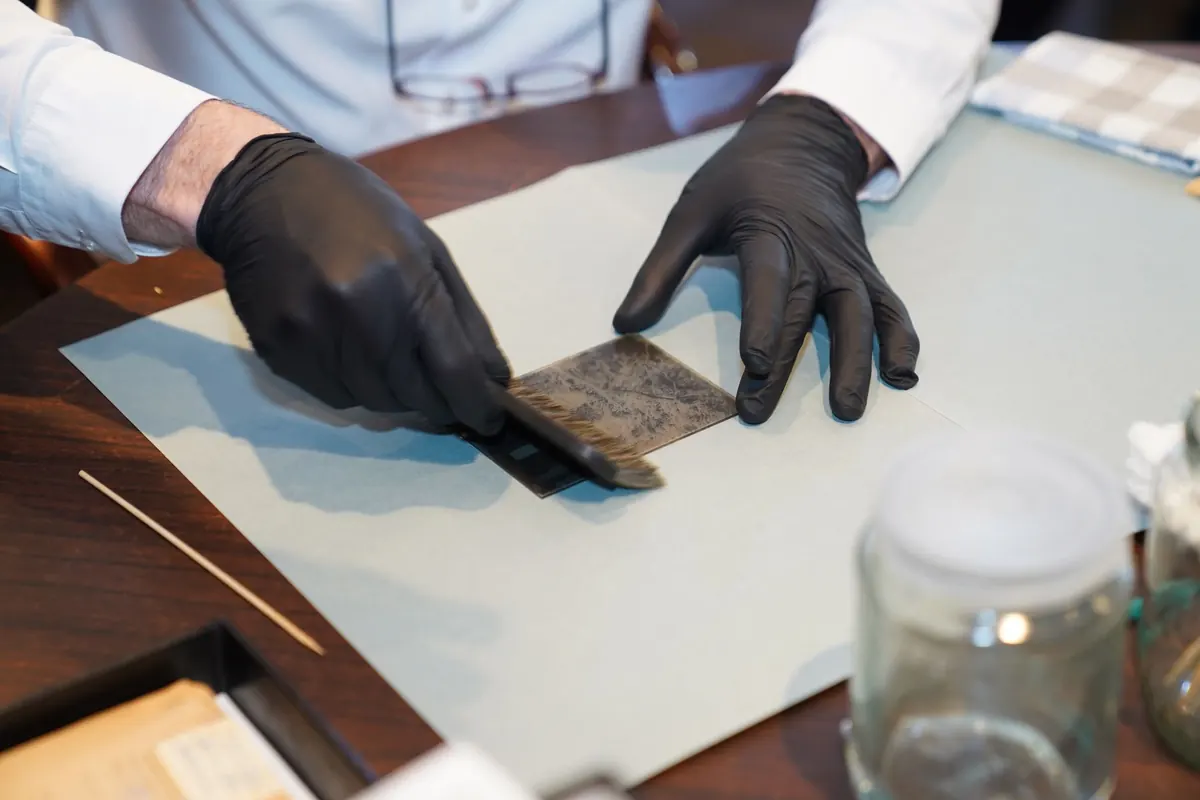
Lime plaster does not consult a calendar. It responds to the air around it, and that air changes with the season — sometimes with the hour. Anyone who has laid a giornata on a cool October morning and then tried the same mix on a July afternoon knows the difference: one stays open for six hours, the other tightens before the coffee is finished. Seasonal timing is not a scheduling nicety in fresco work. It decides how much you can paint in a day, how the pigment sits in the lime, and whether the surface will still be sound in twenty years.
What the Lime Is Doing While You Paint
Fresh lime plaster is a chemically active surface, not a passive board. The pigment you brush on sinks a fraction of a millimetre into the wet lime, and as water leaves the plaster, calcium hydroxide takes carbon dioxide from the air and slowly becomes calcium carbonate. That reaction is what locks the colour into the wall. It needs moisture to proceed evenly, and it needs time.
When the plaster dries too fast, a skin forms before the pigment has been properly drawn in, and the colour sits on the surface like dust. When it dries too slowly, the surface stays open and the pigment can drift, bleed into the next patch, or lift under a wash of limewater. Between those two failures lies a wide, workable middle, and the weather outside the window is what pushes you toward one end or the other. Temperature and humidity are the two numbers that matter, and they rarely move independently.
Heat and Dry Air: The Shrinking Giornata
In high summer, or in a room with the heating running hard, a giornata you would paint comfortably in April can tighten in two or three hours. The signs are easy to read once you have seen them: the plaster loses its cool sheen, the brush starts to drag, and pigment that flowed a moment ago suddenly sits up on the surface. The painted edge, always the first to dry, stiffens, and the join to the next patch becomes a visible line you will be looking at for years.
Some adjustments worth making before the heat arrives:
- Start at first light. Lay the giornata early and paint the difficult passages — faces, hands, fine detail — while the surface is at its most forgiving.
- Shade the wall, not the room. A canvas or shade cloth hung outside a south-facing window does more good than any amount of spraying.
- Work smaller. Reduce the size of each giornata by a third or a half and accept the extra joins. A small patch finished well beats a large one finished badly.
- Keep the lower edge damp. A damp cloth laid along the bottom of the giornata slows the drying front without soaking the area you are painting.
- Close the windows. A breeze across fresh plaster is the fastest way to lose a morning's work; it pulls moisture out of the surface unevenly.
Misting helps in dry heat, but lightly and from a distance. Water pooling on a half-set surface will damage the skin you are trying to protect.
Cold, Damp and the Limits of Lime
At the other end of the scale, lime simply stops. Below roughly five degrees Celsius, setting and carbonation effectively stall, and the plaster stays dark, soft and vulnerable. Frost is worse than a delay: ice forming in fresh lime plaster destroys its structure, and the damage does not repair itself in spring.
Cool, damp conditions bring their own problems. Carbonation drags on, condensation forms on cold masonry, and salts can bloom through the surface as efflorescence, leaving pale patches and a crumbling skin. Pigment applied to plaster that is wet rather than damp may float or bleed. If you must work in these conditions, hydraulic lime or a pozzolana-bearing mix will set in damper, cooler air than pure air lime, and a tented scaffold with gentle background heat can buy you a workable window. Avoid blasting the surface with a direct heater: rapid drying causes shrinkage cracks that no amount of careful painting will hide.
The Indoor Season Is Its Own Climate
Interior fresco has seasons too, and they often run against the ones outside. Winter heating pulls relative humidity down to thirty per cent or lower, which makes plaster behave as though it were July. Summer air conditioning does much the same in reverse, drying a room that would otherwise be perfectly workable.
A cheap hygrometer is the most useful instrument on the site. Keep it beside the scaffold, check it morning and afternoon, and write the readings down with the day's notes. If the air is too dry, a humidifier in the room and closed doors will do more than any change to the mix; if the wall itself is cold — a church interior in winter, a north-facing masonry wall — warm, moist room air will condense on it, and no schedule will save a giornata laid on a sweating surface. Watch the wall as carefully as the thermometer.
How Pigments Behave Differently by Season
Every fresco painter learns to read colour wet, which is not how anyone else will ever see it. In humid weather the plaster stays darker for longer and the whole palette reads deeper; in dry heat the surface lightens fast and colours appear to jump away from you. That shift changes your judgement of value, especially in the mid-tones.
Some pigments are also more sensitive than others to a long, wet set. Earths are steady and forgiving; certain lakes and organic colours are not, and a slow, damp carbonation gives them more time to migrate or fade. Mix a small test panel at the start of each season with the pigments you plan to use, lay it on the same wall, and keep it. A season's test panels are a better reference than memory.
A Fresco Year, Roughly
Schedules differ by building, exposure and climate, but the shape of a working year tends to look like this:
- Late winter: preparation. Slake lime putty so it has months to mature, grind and wash pigments, finish the cartoon and the sinopia, and plan giornate sizes against the forecast.
- Spring: the best general window in most temperate climates. Mild temperatures and moderate humidity let you lay generous giornate on exterior and interior walls alike.
- Summer: early starts, shaded walls, smaller patches. Reserve the middle of the day for drawing, mixing and preparation rather than painting. Interiors on north-facing walls stay workable longer.
- Early autumn: the second good window. Warm walls and softer air make it a favourite for exterior work that must be finished before the cold.
- Winter: time for portable panels, fresco secco touch-ups, documentation, and maintenance inspections of existing work. Keep an eye on any recently finished plaster through the first cold snap.
Plan the Season, Then Plan the Day
Build slack into the schedule rather than trusting a single ideal week. If a giornata is lost to rain or heat, tomorrow's should be smaller, not doubled to catch up. Keep a log of temperature, humidity and how the plaster actually behaved — after two or three seasons it becomes the most reliable planning tool you own.
One last practical note: lime is caustic, so gloves, eye protection and sensible ventilation are part of the kit, not an optional extra. And if you are working on historic or protected plaster, have the condition of the wall assessed by a conservator before committing a season's work to it. A schedule is easy to move; masonry is not.
Photo: Pexels / Pixabay